





CNC Router for Woodworking Shop: How the Right Machine Boosts Production at Any Scale
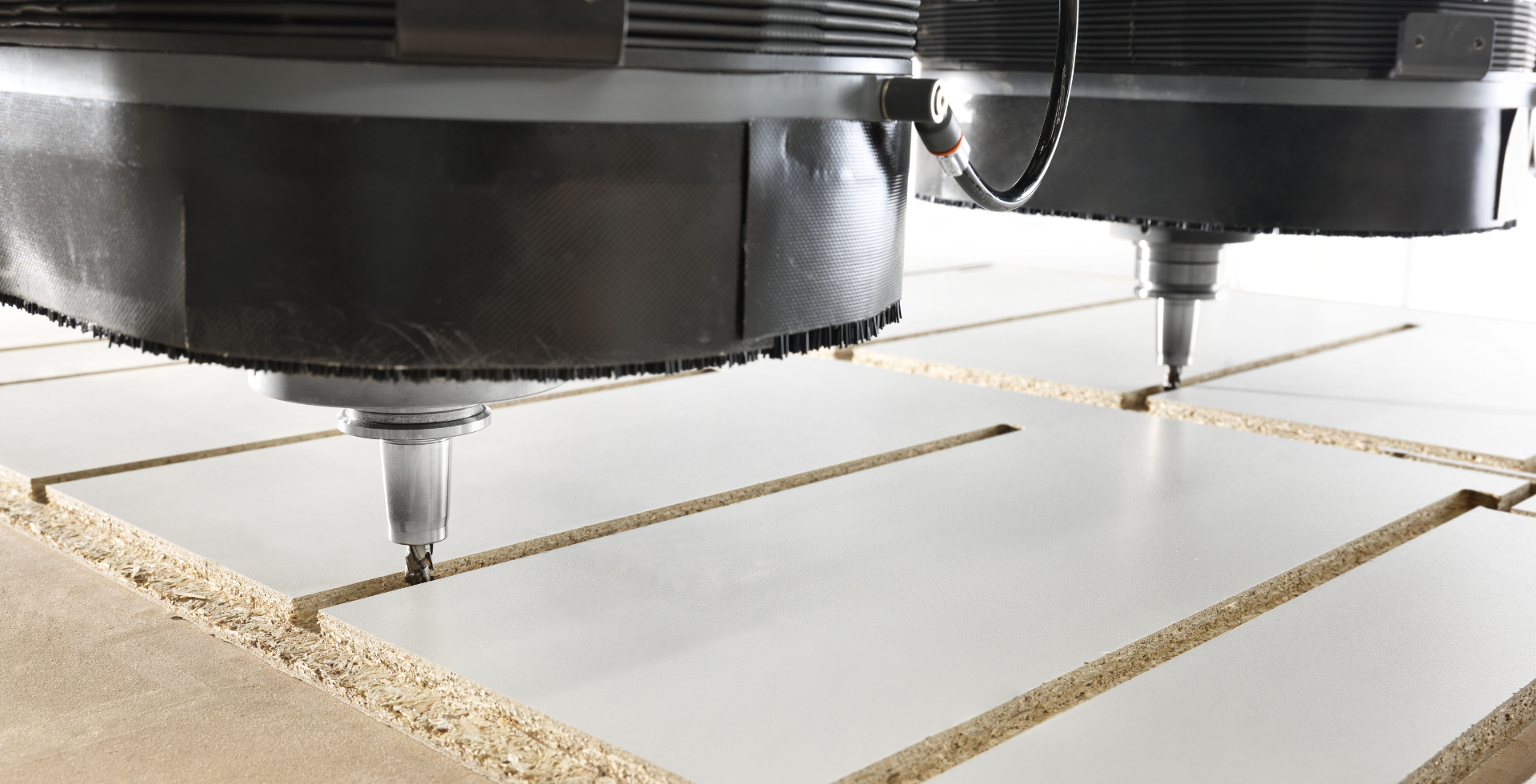
Choosing the right CNC router for your woodworking shop is one of the most consequential equipment decisions you’ll make—it affects your throughput, labor costs, material waste, and ultimately how many jobs you can take on in a given month. Whether you’re running a two-person custom cabinet shop or a full production floor, a CNC router changes the math on what your shop can produce.
In this guide, we’ll cover what a CNC router actually does for production, how shops of different sizes benefit in different ways, what to look for when comparing machines, and what Biesse brings to the table for woodworking businesses that want to scale without sacrificing quality.
What Is a CNC Router, and Why Does It Matter for Woodworking Production?
A CNC (Computer Numerical Control) router is a machine that cuts, drills, and shapes wood, panel stock, and composite materials by following a digital program instead of a hand-guided tool. You design or import a part in CAD/CAM software, the machine translates that file into a toolpath, and the router executes it with a rotating spindle across two, three, or more axes of motion.
For a woodworking shop, that shift from hand tools to programmed motion is what unlocks a production boost. Here’s why.
Speed That Compounds Over a Shift
A CNC router runs a toolpath in a fraction of the time it takes to hand-cut the same part—and unlike a person, it doesn’t slow down as the day goes on. On a single part, the time savings might look modest. Multiply that across dozens or hundreds of parts, and the difference adds up to real reclaimed shop hours every week. Those hours translate directly into more jobs your shop can take on without adding a shift.
Tighter Tolerances Mean Less Rework
Every hand-cut part carries some amount of variation, even from your most experienced woodworker. That variation shows up as extra sanding, extra fitting, and occasionally a scrapped piece. A CNC router holds the same tolerance on part one and part one thousand. Less variation means less rework, which means fewer labor hours spent fixing problems instead of building new orders.
Complex Joinery and Detail Work Without Extra Labor
Dovetails, curved panels, intricate inlays, and repeatable joinery are all things a CNC router handles as easily as a straight cut. Work that used to require a specialist—or hours of careful hand-tool work—can now run largely unattended once the program is set. That opens the door to more sophisticated product offerings without adding to your labor budget.
One Operator, Multiple Machines
Because a CNC router runs its program automatically, a single trained operator can often oversee two or three machines at once—loading stock, starting cycles, and unloading finished parts while the machine does the cutting. That’s a direct multiplier on your shop’s output per employee, which matters a lot when skilled labor is expensive or hard to find.
Nesting Software Reduces Material Waste
Modern CNC router software includes nesting tools that automatically arrange parts across a sheet to minimize offcuts. Less wasted plywood, MDF, or composite stock means more finished parts per sheet, which lowers your material cost per unit and stretches your raw stock further—a real bottom-line impact for shops running sheet goods daily.
Faster Prototyping Means Faster Sales
When a customer wants a custom piece or a design variation, a CNC router lets you go from a CAD file to a finished sample in a single setup instead of hand-building a template first. That turnaround can be the difference between winning a custom order and losing it to a competitor who can show a sample faster.
Predictable Output for Better Scheduling
Manual work has natural variability: fatigue, small errors, and differences between operators on a given day. CNC-cut parts come out at a known, repeatable cycle time. That predictability makes it far easier to quote realistic lead times, plan your production schedule, and commit to delivery dates with confidence—which matters just as much to your customers as it does to your shop floor.
Do Small Woodworking Shops Actually Benefit from a CNC Router?
It’s a common misconception that CNC routers only make sense for high-volume production floors. In reality, smaller custom woodworking shops often see the biggest relative gains, because every hour saved represents a larger share of total shop capacity.
If you’re running a two- or three-person operation taking on custom cabinetry, architectural millwork, signage, or furniture work, adding a CNC router lets you:
- Quote and turn around custom one-off pieces faster, since you can go from a CAD file to a finished part without hand-building a template first
- Take on more complex work—inlays, curved parts, repeatable joinery—without hiring a specialist or subcontracting it out
- Free up your most skilled people for finishing, assembly, and higher-value work instead of repetitive cutting
- Compete on turnaround time with larger shops, even with a small crew
- Reduce material waste on expensive hardwoods and sheet stock, where every offcut has real cost
Right-sized machines and flexible financing options make it realistic for a small shop to add a CNC router without taking on production-floor-scale overhead. You don’t need a 5-axis machining center to get meaningful production gains—you need a machine sized to your actual parts and volume.
What to Look for When Comparing CNC Routers for a Woodworking Shop
Not every CNC router is built the same way, and the right specification depends heavily on what you’re producing. A few things worth evaluating as you compare machines:
- Work area / table size. Match this to your largest common part or sheet size (a standard 4' x 8' panel is the usual benchmark for cabinet and panel shops).
- Spindle speed and power. Higher-RPM spindles generally handle a wider range of materials and finishes with less tear-out, which matters for hardwoods and veneers.
- Automatic tool changers (ATC). An ATC lets the machine switch between bits automatically mid-program, which is essential once you’re running multiple operations (routing, drilling, boring) on the same part without manual intervention.
- Vacuum hold-down systems. These secure your material to the table without clamps that get in the way of the toolpath, and they speed up changeover between parts.
- Nested-base capability. If you’re processing a lot of sheet goods into cabinet parts, a nested-base setup with labeling can move you from raw sheet to finished, labeled parts with minimal manual handling.
- Control software and CAD/CAM integration. How easily the machine’s software integrates with your existing design workflow affects how much time you spend programming versus cutting.
- Service and parts support. A CNC router is a long-term capital investment. Local service, training, and parts availability matter as much as the spec sheet—a machine that’s down for two weeks waiting on a part is a machine that isn’t making you money.
Biesse: CNC Routers Built for Every Shop Size
At John G. Weber Co., Biesse is one of the core CNC router brands we carry. Part of what makes them a strong fit across our customer base is the range within their lineup—from more compact machines suited to smaller custom shops to full production-floor systems.

Biesse Rover Series (Production-Scale)
At the production end, the Biesse Rover series is built for cabinetry, furniture, and panel processing at scale. Depending on configuration, Rover machines are commonly equipped with:
- High-speed spindles, often rated up to 24,000 RPM
- Automatic tool changers with a dozen or more tool positions
- Boring heads with multiple independent spindles for drilling and doweling in the same cycle
- Nested-base worktables with matrix-grid phenolic surfaces designed for high-volume sheet processing
- Optional automatic labeling systems that tag parts as they come off the machine, streamlining assembly downstream
For shops running nested-base manufacturing—producing cabinet parts, closet systems, or store fixtures at volume—the Rover line is designed to move from raw sheet to finished, labeled parts with minimal manual handling between operations.
Compact Biesse Machines (Small Shop-Scale)
For smaller shops, Biesse also offers more compact machines with a smaller footprint and lower entry cost, while carrying forward the same build quality and control software found on their larger systems. That means a smaller custom shop isn’t sacrificing reliability or software capability just to fit a machine into a tighter space or a leaner budget—you’re scaling the machine to your shop, not compromising on what it can do.
Exact spindle power, table size, and tool-changer configuration vary by model and options. Because configurations change and are matched closely to each shop’s actual parts and volume, the best next step is a conversation with our team to identify the right Biesse setup for your production goals.
Where to Start: Identifying the Right First (or Next) CNC Router
If you’re building the case for a new CNC router—or your first one—start by looking at the parts of your workflow with the most repetition: cabinet doors, shelving, signage blanks, or any part you cut the same way more than a few times a week. Those are the jobs where a CNC router pays for itself fastest, and where the production boost will be most obvious on your shop floor.
From there, the right machine comes down to matching table size, spindle capability, and tooling options to your actual parts—not buying more machine than your shop needs, or under sizing a machine you’ll outgrow in a year.
Let’s Work Out the Right Solution for Your Shop
Since 1989, John G. Weber Co. has supplied woodworking shops across the country with the machinery and support to keep production moving. Whether you’re a small custom shop evaluating your first CNC router or a larger operation ready to add production capacity, our team will work with you directly to identify the Biesse configuration that fits your space, your parts, and your budget.
Contact John G. Weber Co. today, and let’s talk through the right CNC router solution for your woodworking shop.